The most frequent assumption in the strength of the material is homogenous and isotropic. Homogenous and isotropic terms are defined here.

Before starting the strength of the material, you need to clearly understand homogenous and isotropic material as you keep making these assumptions about the material. In this post, you will learn about homogenous and isotropic materials. Apply the concept of homogenous and isotropy symmetry in the constitutive relation.
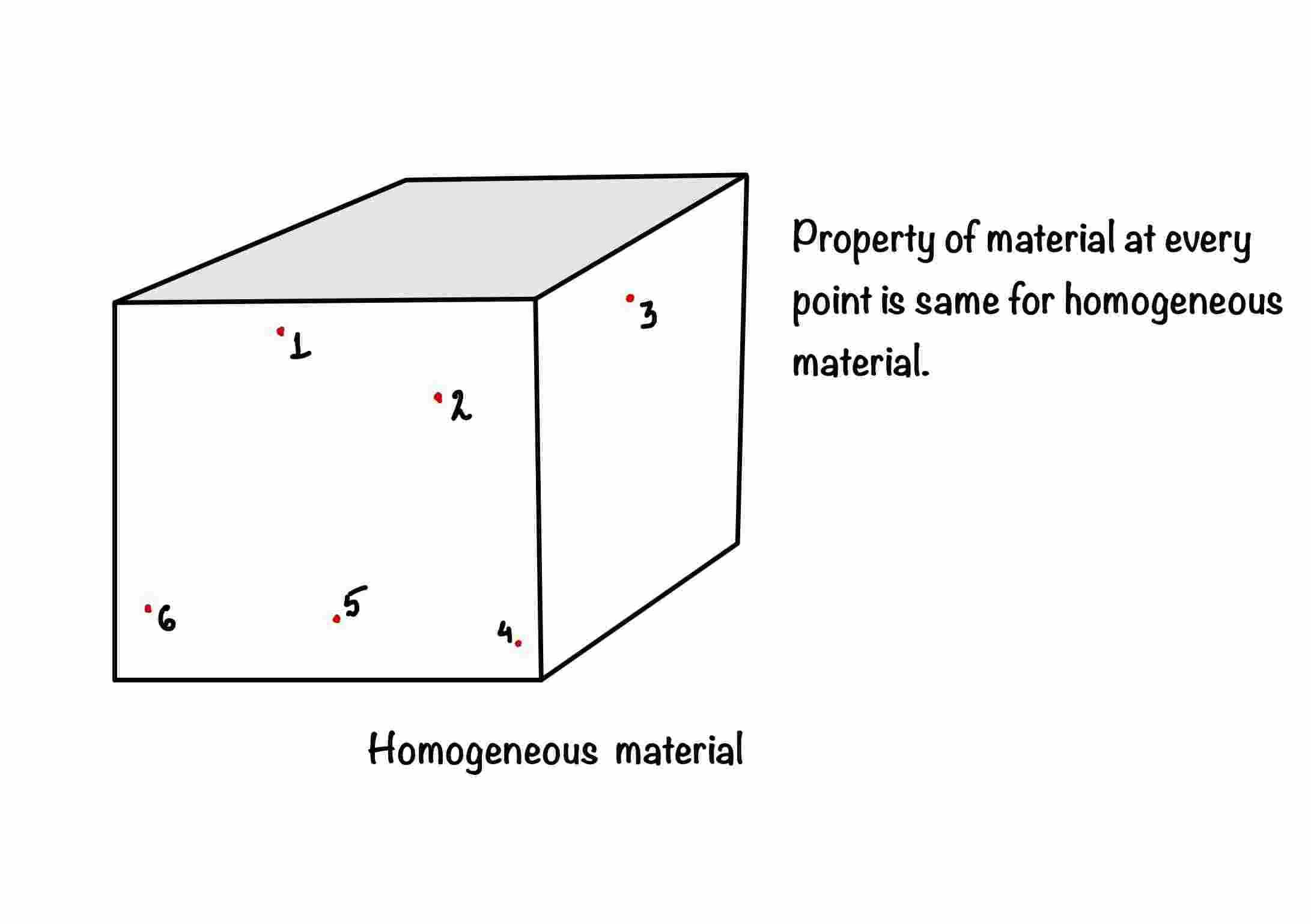
In nature, there is no homogeneity, which means nature tries to create unique things. But we want to make things homogenous to economize things. Homogenous materials have the same properties at all points. If you take a random point inside the material, all the points have the same material properties. The figure shows different points inside the material. If the material properties at every point are the same, this is called homogenous material.
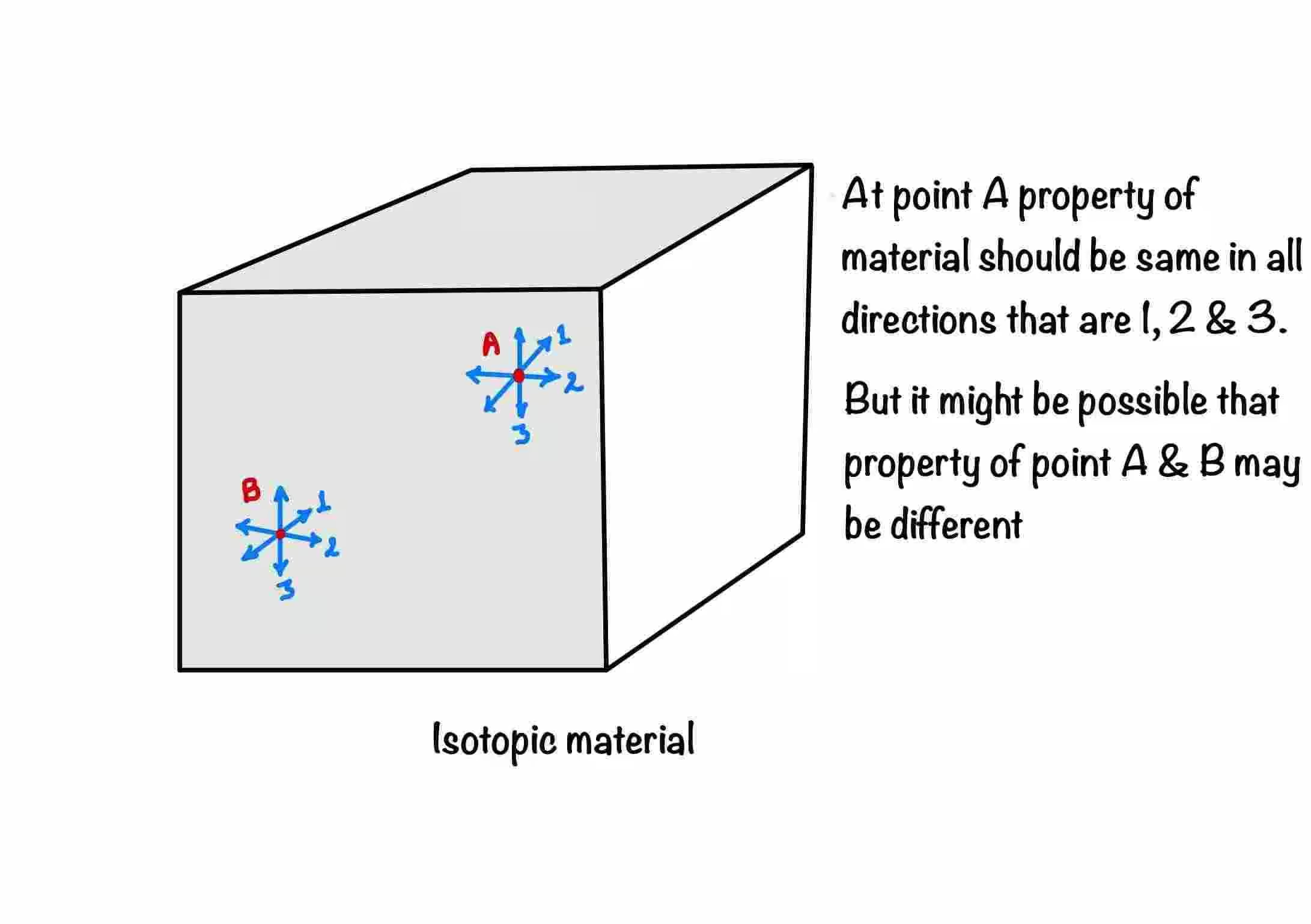
The word “isotropy” means the same in all orientations. Hence isotropic material has the same properties in all directions. If you choose any point inside the material, isotropic materials have the same properties in all directions.
Well, to be honest, these material properties are very useful in different engineering domains while deriving fundamental relations. For example, in the strength of the material, we generally derive the pure bending theorem of the beam, pure torsion relation of the shaft, and column buckling. We assume that the material is homogenous and isotropic. Hooke’s law is also derived for the homogenous and isotropic material. We have used this assumption even in the derivation of Poisson’s ratio.
To derive the fundamental relations in engineering, we need to simplify the real-life problem without changing the nature of the problem. Assuming material is homogenous and isotropic is one of the most essential assumptions which make issues simple.
In this small post, you have learned that
Your trusted source for breaking down core engineering concepts using first-principles thinking.