Effect of different concentration of admixture in concrete mix design is studied in 2 mins using the concrete mix design calculator.

Admixtures are chemical compounds that alter the properties of concrete. We can add admixtures before or during the concrete mix as an ingredient of concrete, other than cement, aggregate, and water. The mostly used admixture is plasticizers and super plasticizers. We use different types of admixtures, for different functions.
Check this post to learn about admixtures.
The Concrete Mix Design app will help you quickly grasp the concept of mix design as it is effortless to use and has an excellent graphical interface. Here you can go a step further by varying the parameters and analysing the effect in design to get a in depth knowledge.
Here you will understand the effect of admixtures in concrete mix design through our concrete mix design application, this will also help you to apply this knowledge to your university course or at site in practical situations.
In this tutorial, you'll learn:
The different design stipulations required for the desired mix are shown in the table below:
| Stipulations for proportioning | |
|---|---|
| Type of Concrete | RCC |
| Grade Designation | M50 |
| Shape of Particle | Angular |
| Slump | 50 mm |
| Water- Cement Ratio | 0.39 |
| Exposure Condition | Severe |
| Concrete Placement | Pump |
| Degree of Supervision | Good |
The different experiemental data required for the desiered mix are shown in the table below:
| Test data for materials | |
|---|---|
| Standard Deviation | -- |
| Specific Gravity of Fine Aggregate | 2.65 |
| Specific Gravity of Coarse Aggregate | 2.62 |
| Specific Gravity of Cement | 3.15 |
| Specific Gravity of Admixture | 1.145 |
| Water absorption of Fine Aggregate | 1.0 % |
| Water absorption of Coarse Aggregate | 0.5% |
| Free Surface Moisture of Fine Aggregate | Zero |
| Free Surface Moisture of Coarse Aggregate | Zero |
| Sieve analysis | |
|---|---|
| Fine Aggregate | Zone 2 |
| Coarse Aggregate | 20 mm |
| Case 1 : Chemical Admixture | |
|---|---|
| Volume ( By mass of cement) | 2% |
| Water Content Reduction | Zero |
| Case 2 : Chemical Admixture | |
|---|---|
| Volume ( By mass of cement) | 4% |
| Water Content Reduction | Zero |
| Case 3 : Chemical Admixture | |
|---|---|
| Volume ( By mass of cement) | 6% |
| Water Content Reduction | Zero |
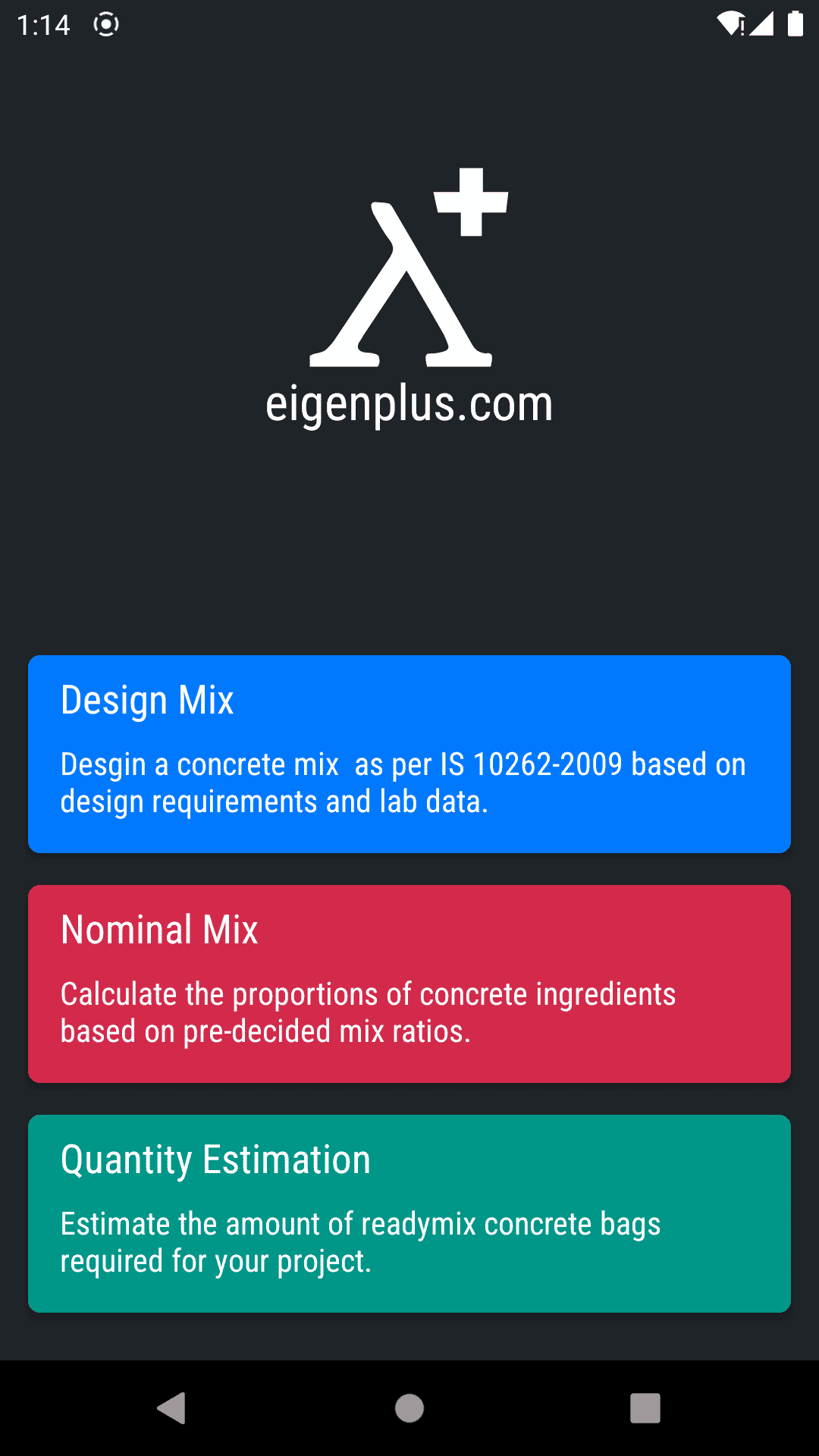
Step 1: Download the application from play store and install it. Once you are done with the installation, open the application and select the first option "Design mix" -to design a concrete mix as per IS 10262:2009.
Step 2: Input the data as per the problem. The different stipulations for proportioning, data of sieve analysis of aggregates, data of chemical admixtures if applicable, and also the different test data for materials.

Step 3: Next just press the play symbol, to get the final output.
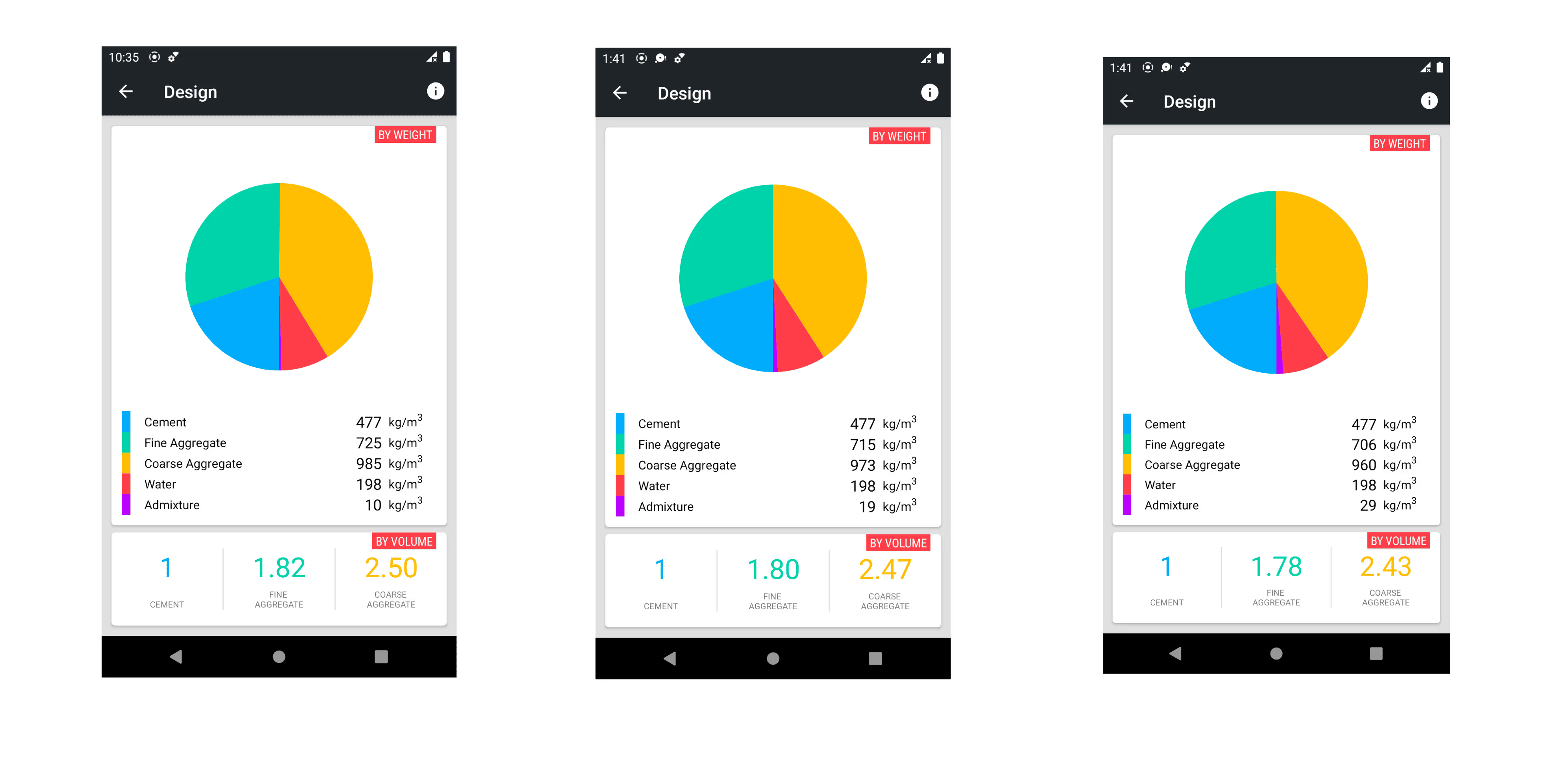
Design mix ratios with different admixture content (a) Case 1 (b) Case 2 (c) Case 3
In this result it is evident that when you change the admixture content there is a significant difference in the design mix ratio of concrete, though all the other parameters are kept the same. The aggregate content is changed, in this problem as this depends on the type of admixtures used.
We hope you understand the concept of design and how different concentration of admixture effect a design mix of M-50 concrete. Further, you can use CMD app to change the parameter and study the effect on design mix.
Your trusted source for breaking down core engineering concepts using first-principles thinking.